

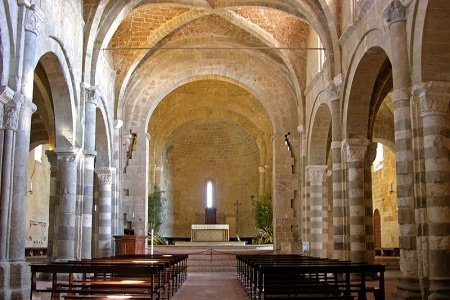
 Cathedral
The cathedral of Saints Peter and Paul is one of the most important monuments of Romanesque art in the Maremma and Tuscany.
It must have been built over a rather long period of time, between the 10th and 13th centuries, also reusing fragments of an older sacred building, perhaps a primitive cathedral dedicated to San Mamiliano, the mythical evangelist of Sovana, later dismantled and replaced in its functions by the new building.
Reconstructing its history is very complex: the documents that talk about it are few, perhaps also due to the fire that destroyed the diocesan archive in the 16th century. A bull from Pope Nicholas II, from 1061, recalls that the bishop of Sovana Ranieri, who lived in the mid-10th century, had founded the chapter of the canons of the cathedral; the oldest nucleus of the building could therefore date back to that period, perhaps to be identified in the crypt. In the lunette of the entrance portal an inscription mentions a bishop Pietro to be identified with the one who governed the diocese between 1153 and 1175: therefore a good part of the internal decorative apparatus of the church must date back to this period. A second inscription walled up outside the transept, dated 1248, must instead refer to a consolidation intervention, when the construction of the church was not yet completed, the greatest evidence of which is given by the external buttresses, but it cannot be ruled out that also report the construction of the masonry vaults, the construction of which was probably not envisaged by the original project which perhaps included simple wooden trusses instead. Over the centuries the church underwent numerous restorations and renovations, one of which is commemorated by a plaque inside the church, dated 1672.
WHAT TO SEE:
One of the most interesting features of the Sovana Cathedral is the ancient portal, created using reliefs both from an older building and created specifically. Note the figurine of a praying woman at the top of the arch, the two-tailed mermaid (symbol of fertility, but also of lust) on the left side and the knight on the right. Inside, all the capitals are different from each other. The only one with figurative scenes is the second in the left aisle, not surprisingly the one closest to the entrance. On it are represented Daniel in the lions’ den, Moses separating the waters of the Red Sea, Adam and Eve expelled from the Garden of Eden, the delivery of the keys to Saint Peter, Abraham among his wives, the sacrifice of Isaac, an eagle that seizes prey. The baptismal font, placed in its current location only in 1971, is dated 1494; always on the XV
the urn of San Mamiliano dates back to the century, perhaps moved here from the church dedicated to the saint, which remained abandoned and in ruins for a long time, while the stoup in the left side nave dates back to 1615, one of the few works of art present in Sovana dating back to a period that for the city was one of strong decline and abandonment.
HOW TO REACH IT:
The cathedral is located at the end of the street of the same name, 400 m from Piazza del Pretorio, the heart of the city.
TIMETABLES:
Summer: 09.00-13.00; 15.00-20.00; winter: 10.00-13.00; 15.00-18.00; entrance ticket €2
IN THE SAME AREA YOU CAN ALSO VISIT:
Praetorian Square; Church of Santa Maria; Fortress of Sovana; Città del Tufo Archaeological Park (Etruscan necropolis); church of San Mamiliano with Museum.
IF YOU LIKED THE SOVANA CATHEDRAL YOU CAN ALSO VISIT:
Church of San Giorgio in Montemerano (22 km); Basilica of the Holy Sepulcher in Acquapendente (28 km); Church of SS. Peter and Paul in Roccalbegna; Abbey of S. Salvatore in Abbadia S. Salvatore (40 km); Church of San Bruzio in Magliano (45 km); Churches of San Pietro and Santa Maria Maggiore in Tuscania (42 km); Church of San Flaviano in Montefiascone (52 km); Orbetello Cathedral (59 km).
The cathedral of Saints Peter and Paul is one of the most important monuments of Romanesque art in the Maremma and Tuscany.
It must have been built over a rather long period of time, between the 10th and 13th centuries, also reusing fragments of an older sacred building, perhaps a primitive cathedral dedicated to San Mamiliano, the mythical evangelist of Sovana, later dismantled and replaced in its functions by the new building.
Reconstructing its history is very complex: the documents that talk about it are few, perhaps also due to the fire that destroyed the diocesan archive in the 16th century. A bull from Pope Nicholas II, from 1061, recalls that the bishop of Sovana Ranieri, who lived in the mid-10th century, had founded the chapter of the canons of the cathedral; the oldest nucleus of the building could therefore date back to that period, perhaps to be identified in the crypt. In the lunette of the entrance portal an inscription mentions a bishop Pietro to be identified with the one who governed the diocese between 1153 and 1175: therefore a good part of the internal decorative apparatus of the church must date back to this period. A second inscription walled up outside the transept, dated 1248, must instead refer to a consolidation intervention, when the construction of the church was not yet completed, the greatest evidence of which is given by the external buttresses, but it cannot be ruled out that also report the construction of the masonry vaults, the construction of which was probably not envisaged by the original project which perhaps included simple wooden trusses instead. Over the centuries the church underwent numerous restorations and renovations, one of which is commemorated by a plaque inside the church, dated 1672.
WHAT TO SEE:
One of the most interesting features of the Sovana Cathedral is the ancient portal, created using reliefs both from an older building and created specifically. Note the figurine of a praying woman at the top of the arch, the two-tailed mermaid (symbol of fertility, but also of lust) on the left side and the knight on the right. Inside, all the capitals are different from each other. The only one with figurative scenes is the second in the left aisle, not surprisingly the one closest to the entrance. On it are represented Daniel in the lions’ den, Moses separating the waters of the Red Sea, Adam and Eve expelled from the Garden of Eden, the delivery of the keys to Saint Peter, Abraham among his wives, the sacrifice of Isaac, an eagle that seizes prey. The baptismal font, placed in its current location only in 1971, is dated 1494; always on the XV
the urn of San Mamiliano dates back to the century, perhaps moved here from the church dedicated to the saint, which remained abandoned and in ruins for a long time, while the stoup in the left side nave dates back to 1615, one of the few works of art present in Sovana dating back to a period that for the city was one of strong decline and abandonment.
HOW TO REACH IT:
The cathedral is located at the end of the street of the same name, 400 m from Piazza del Pretorio, the heart of the city.
TIMETABLES:
Summer: 09.00-13.00; 15.00-20.00; winter: 10.00-13.00; 15.00-18.00; entrance ticket €2
IN THE SAME AREA YOU CAN ALSO VISIT:
Praetorian Square; Church of Santa Maria; Fortress of Sovana; Città del Tufo Archaeological Park (Etruscan necropolis); church of San Mamiliano with Museum.
IF YOU LIKED THE SOVANA CATHEDRAL YOU CAN ALSO VISIT:
Church of San Giorgio in Montemerano (22 km); Basilica of the Holy Sepulcher in Acquapendente (28 km); Church of SS. Peter and Paul in Roccalbegna; Abbey of S. Salvatore in Abbadia S. Salvatore (40 km); Church of San Bruzio in Magliano (45 km); Churches of San Pietro and Santa Maria Maggiore in Tuscania (42 km); Church of San Flaviano in Montefiascone (52 km); Orbetello Cathedral (59 km).
