

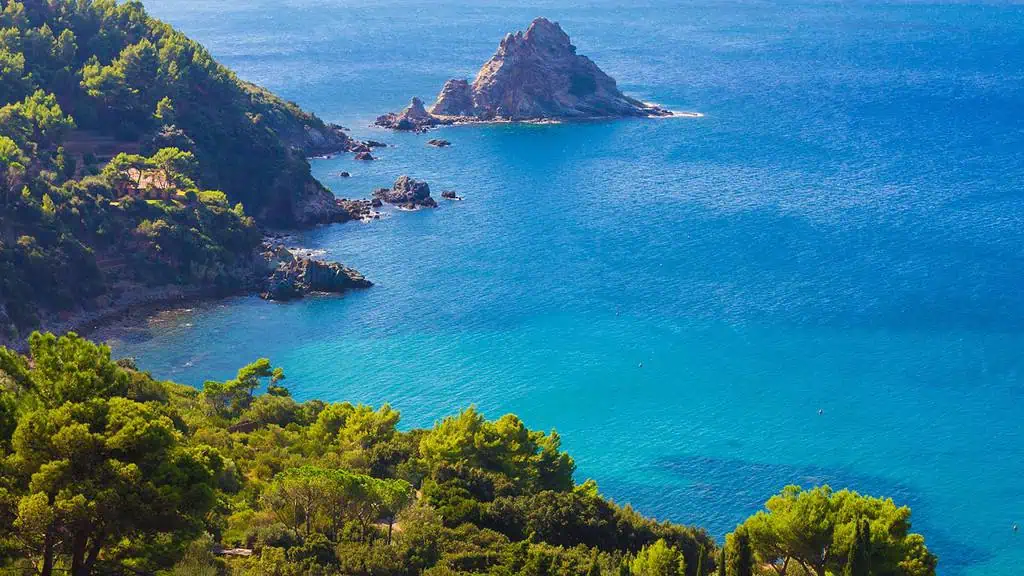
Monte Argentario
The Argentario coast is the right place for a summer escape in Maremma. When the weather becomes unbearably hot, the Maremmani refuge is on the seafront of the port cities of the Argentario and on the soft sand of its beaches.
Life by the sea has made the inhabitants of Argentario robust and resistant. This once Etruscan outpost has faced everything from Roman invasions and Turkish pirate attacks to a 17th-century Spanish occupation and WWII bombings.
Today the Argentario coast is a place of contrasts between fashion and tradition. Unmissable for an elegant holiday are the incredible fish restaurants, bars and discos, which coexist with the places where local fishermen still sell the catch of the day by the sea.
Furthermore, from the Argentario you can take ferries to the islands of the Tuscan archipelago.
IN THE FOREGROUND: A view worth an excursion
The best way to explore the rocky hills of the Argentario promontory is to follow the SP 45 or Panoramica, but be careful, as the road is bumpy and windy. The best place to enjoy a spectacular view is at Capo d’Uomo, from where you can see all the nearby islands. The Overview then winds its way down towards the Cannelle beach.
Continuing, we arrive at Crino Bufalo, where it is possible to park the car and continue on foot the 30-minute walk to the Spanish tower of Punta Ciana. You can also take the SP 45 towards Orbetello to visit the 18th century convent of the Passionist Fathers. For decades people have come to this convent to “eat with the Friars”; and even if the meals are no longer cooked by these friars, the place is still worth a visit. From the convent you can reach the highest point of the Argentario, where a huge iron cross has become a real pilgrimage destination.
The islands of Giglio and Giannutri are part, together with the others, of the Tuscan Archipelago National Park: therefore they are all protected areas. You can find more information about the park and get a list of accredited tour guides, designated trails and dive sites online (www.islepark.it).
IN THE FOREGROUND: a diver’s paradise
The Silver Coast is full of diving spots. The dive schools in the area naturally know where to take you, but if you feel like exploring on your own, there are two places that can’t be missed. The first is the wreck of a shipwreck, the Nasim, which sank off the coast of the island of Giannutri in 1976 with a load of luxury cars, some of which can still be seen underwater. The latter is known collectively as the Formiche di Grosseto, where the natural beauty of the reef is accentuated by archaeological finds that have fallen from ships over the centuries.
NOT TO BE MISSED
• The splendid Tarot Garden of Capalbio, 3 hours.
• A tasting of the “Maremma caviar”, the bottarga, in his hometown, Orbetello, a lunch break.
• The view from Fort Stella to Porto Ercole at sunset, 1 hour.
• Eating seafood, snorkeling or simply relaxing on the idyllic islands of Giglio and Giannutri, a day-long ferry trip.
ITINERARY
Start your weekend on the Silver Coast with a visit to the Talamone Frontone at the Archaeological Museum of Orbetello. Have lunch and take an afternoon stroll along Corso Italia before heading to the coast. Travel along the SP 45 to enjoy some spectacular views heading towards Porto Ercole, where you can stroll through the historic center and see the Spanish tombs in the church of Sant’Erasmo. Go back on the SP 45 to Porto Santo Stefano, where a delicious fish-based dinner and the lively port await you. The next day, hop on a ferry to Giglio and/or Giannutri or spend a day on Giannella beach. Alternatively, head to Capalbio early to explore the Tarot Garden.
WHAT SEE
Port Santo Stefano
It is one of the two characteristic villages that stand on the Tuscan promontory, it is located on the northern part of the Argentario. It is the largest of the villages on the promontory. Porto Santo Stefano has a very ancient history, thanks to its strategic position it was already frequented by the first peoples who sailed in the Mediterranean, subsequently the town was conquered by the Romans, who built important buildings here, such as the Baths of Domitian. During the period of Spanish domination, with the State of the Presidia, the imposing Spanish Fortress was built.
What to see in Porto Santo Stefano:
- Spanish Fortress, built between the end of 1500 and the beginning of 1600 for defensive purposes. In the 19th century, during the Napoleonic era, the building was fortified to resist British attacks and was then restored by Lorraine, following its annexation to the Grand Duchy of Tuscany. Today the fortress hosts events and exhibitions.
- Church of Santo Stefano, a modern church rebuilt after the Second World War to replace the previous eighteenth-century church destroyed by the bombings of 1944
Porto Ercole
Porto Ercole is certainly one of the most characteristic villages of the Argentario, and is also included among the Most Beautiful Villages in Italy. The area has been inhabited since the Etruscan period, as evidenced today by the numerous finds found near the city. It was then conquered by the Romans, who made it a port. In medieval times Porto Ercole is remembered in a donation made by Charlemagne to the Abbey of the Tre Fontane in Rome, the Aldobrandeschi then had the Torre di Terra erected, later transformed into the Rocca di Porto Ercole. With the arrival of the Spaniards, Porto Ercole became part of the State of the Royal Presidia, and it was in this period that Forte Stella, Forte Santa Caterina and Forte Filippo were built.
What to see in Porto Ercole:
- Church of Sant’Erasmo, a beautiful church that stands in a dominant position over the town of Porto Ercole, was built starting from a pre-existing building dating back to the 4th century. In 1600 the church was restored in Tuscan-Baroque style.
- Palazzo dei Governanti, rises in the heart of Porto Ercole and dates back to the first half of the 16th century, built as a residence for the Spanish rulers.
- Rocca Aldobrandesca, built over several centuries, between the Middle Ages and the Renaissance, the fortress dominates the entire Argentario promontory, and is flanked by the Porto Ercole lighthouse.
- The forts Filippo, Stella and Santa Caterina, three characteristic defensive fortifications erected during the Spanish rule of the State of the Royal Presidia.
Orbetello
Famous for its lagoon, Orbetello is one of the most fascinating cities in Tuscany. The town is connected to the Argentario promontory by an artificial dam which divides the lagoon into two: Laguna di Levante and Laguna di Ponente. Inhabited since the Etruscan period, Orbetello was donated by Pope Gregory VII to the Tre Fontane Abbey in Rome. It was then a possession of the Aldobrandeschi and the Orsini counts. In the first half of the 15th century it passed to the Sienese, to then pass, starting from the second half of the 1500s, to the State of the Royal Spanish Presidia, and then to pass under the control of Naples, the Grand Duchy of Tuscany, until its annexation to the Kingdom of ‘Italy. Orbetello is also known because between 1927 and 1933 Italo Balbo left there for his four seaplane air cruises.
What to see in Orbetello:
- Co-cathedral of Santa Maria Assunta, is the Cathedral of Orbetello, it was built on the ruins of a Roman temple, dating back to the fifth century, it was enlarged in 1201 and rebuilt between 1370 and 1376 at the behest of the Orsini Counts. Inside you can admire some precious paintings, such as the Circumcision, the Assumption of the Madonna, the Madonna seated among angels against the backdrop of the Orbetello lagoon and the mysteries of the Rosary.
- Cinta Muraria, built by the Etruscans around the 5th century BC. it was enlarged in the Middle Ages, in 1500 by the Spanish, including the Fortress, the Porta Medina Coeli, Porta a Terra and Porta del Soccorso.
- Governor’s Palace, in Piazza Hero dei Due Mondi, was the official residence of the governor general of the State of the Presidia.
Talamone
- Church of Santa Maria Assunta, dating back to 1374, the church was built on the ruins of a sacred building from the 5th century BC. and remodeled in 1600. Inside the church you can admire a beautiful fresco from the 1400s, with the Madonna of Constantinople, a fresco with the Madonna and Child between St. Peter and St. Paul, from the end of the 1400s and from the Sienese school, and a wooden choir 1614.
- Rocca Aldobrandesca, a fortification that dominates the entire town of Talamone and the blue waters of the Tuscan coast. It was built in 1200 by the Aldobrandeschi with sighting and defense functions. The structure was enlarged and fortified by the Sienese and restored again in 1400. The fortress was partially destroyed by pirates and rebuilt in the second half of the 1500s.
- Cinta Muraria, originally built during the 1200s by the Aldobrandeschis, the curtain wall was restructured in 1465 and again in 1541. The Spanish fortified the structure between 1500 and 1600.
Lily island
The Island of Giglio is one of the most beautiful islands of the Tuscan Archipelago, located in front of the town of Porto Santo Stefano, about 12 miles from the Argentario. The island was already inhabited from the Iron Age and later became an important Etruscan military base, maintaining its military relevance even in the Etruscan era. The discovery, in Giglio Porto just below sea level, of the ruins of the ancient Roman villa of the Domizi Enobarbi family, consisting of a tank for fish farming, walls, crop-porticos, mosaics, frescoes, arches and a terrace. In medieval times the Giglio became the property of the Aldobrandeschi, to then pass to the city of Perugia, and then to Pisa between 1264 and 1406, later it was a possession of the Medici family of Florence. The island is home to three towns, Giglio Porto, Giglio Castello and Giglio Campese.
What to see on Giglio Island:
- Church of San Pietro Apostolo, is located in Giglio Porto and is a sacred building dating back to the 1400s, inside it houses a precious treasure that belonged to Pope Innocent XIII, an ivory crucifix made by Giambologna, a relic of Saint Joseph, a relic of Pope Urban I, a relic of San Mamiliano and some reliquaries from the 18th century.
- Cinta Muraria, surrounds the town of Giglio Castello and dates back to the medieval period, under the government of the Aldobrandeschi. The walls were seriously damaged during a pirate raid in 1544 and the Medici who ruled the island at the time carried out a major renovation of the structure.
- Rocca Aldobrandesca, in Giglio Castello. It was built in the 10th century as the property of the Tre Fontane Abbey of Rome, in 1100 it passed to the Aldobrandeschi family who expanded the structure. The fortress was restored again by the Pisans and in the 16th century by the Medici. Following some pirate incursions, the fortress was damaged and restored again between the end of the 1500s and the beginning of the 1600s. Other important restoration works were carried out during the eighteenth century, when the lodgings for the sentinels and the manor house were enlarged, and in 1762 the Chapel of Santa Barbara was built.
- Coastal Towers, the island is home to numerous towers, built mainly for defensive purposes, Torre del Saraceno and Torre del Campese.
Giannutri Island
About 8 miles from the Island of Giglio, the Island of Giannutri is one of the most beautiful and particular of the Tuscan Archipelago. The island is uninhabited and access is possible with private boats only in some parts and in any case never too close to the coasts, while organized trips allow you to reach it by ferry. The island was already inhabited during the Bronze Age, it became an important center under the Roman Empire, when the Port and the Villa were built, owned by the Domizi Enobarbi family. After the fall of the Roman Empire the island was abandoned and was frequented exclusively by pirates who landed there to find temporary shelters during their assaults on the Tuscan coasts. In 1861, following the annexation to the Kingdom of Italy, the Capel Rosso lighthouse was built.
What to see on the island of Giannutri:
- Roman ruins, in Cala Maestra you can admire the remains of a Roman villa dating back to the 2nd century, which belonged to the Domizi Enobarbi family (an important senatorial family related to Agrippina, mother of the Roman Emperor Nero)
- Underwater, the island of Giannutri is particularly loved by diving enthusiasts, its seabed is in fact very rich in corals, sponges and gorgonians, even if for the most part inserted in a type 1 protected area, where rowing is therefore prohibited , motor and sailing, diving, bathing and fishing, in any case there are excellent diving spots, at the two wrecks of the Anna Bianca at a depth of 40 meters, and of the Nasim at a depth of 60 meters.
- Protected area, the island is inserted within a protected natural area, it is a site of regional interest located within the Tuscan Archipelago National Park and includes a marine reserve.
NOT TO BE MISSED
ORBETELLO
MAGLIANO IN TUSCANY
PORTO ERCOLE
CAPALBIO
TALAMONE
ISLAND OF GIANNUTRI
GIGLIO ISLAND
PORTO SANTO STEFANO
Magnificent Argentario...
The Argentario is a beautiful promontory overlooking the crystal clear waters of the Tyrrhenian Sea, in southern Tuscany. It is a large green promontory, covered with thick Mediterranean scrub, and with splendid little beaches and hidden coves, a true paradise for lovers of nature and the sea! Certainly not to be missed are the villages of the Argentario, Porto Santo Stefano, Porto Ercole, Orbetello, Talamone and the two islets that rise in front of them, the Isola del Giglio and the Isola di Giannutri...
Porto Ercole
Porto Ercole is truly surprising, small but fascinating and full of historic buildings to visit, and breathtaking beaches where you can spend a pleasant relaxing day... According to some reconstructions, Michelangelo da Caravaggio would have landed on the beaches of Porto Ercole after a long journey by sea from Naples, the seriously ill painter would have been transported to the Hospital of Sant'Erasmo, where he would later die... you can visit today an interesting monument dedicated to him...
Orbetello and its lagoon
We chose to visit Orbetello because we read a lot of information about its lagoon and fell in love with it... in fact, it is already enchanting at first sight, the lagoon where a Spanish mill stands out leads to the ancient town of Orbetello and its main street where we we are granted a pleasant walk among shops, restaurants and ice cream parlors, one of the prettiest villages in the Maremma, just 5 minutes by car from the Argentario!
Weekend on Giglio Island
As lovers of the sea, and of the Maremma, we have visited practically all the main seaside resorts, so we have chosen the Isola del Giglio, one of the most precious pearls of the Tuscan Archipelago, as the new destination for our holidays. The island is truly beautiful, from its characteristic port (where we ate excellent fish dishes) to the beaches with crystal clear water, up to the visit of Giglio Castello, an experience that will definitely be repeated!
Excursion to Giannutri
We spent a very pleasant day on the island of Giannutri taking part in a ferry excursion. We had a great time, the organization was excellent, and even the lunch on board! The island of Giannutri is truly spectacular, uncontaminated and wild, its seabed is among the most beautiful ever seen (certainly a destination for many diving enthusiasts) and the ruins of the Roman villa are very interesting...
