

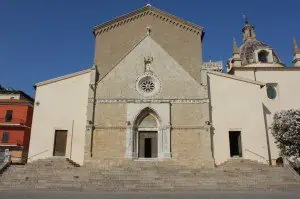
Cathedral
According to a tradition that has not yet been confirmed archaeologically, the Cathedral of Orbetello, dedicated to Santa Maria Assunta, was built on top of a pagan temple in the 5th century AD.
It certainly became the Mother Church of the Tre Fontane Abbey, when in 1230 Pope Gregory IX decided to remove the spiritual care of the city from the diocese of Sovana and submit it directly to the Abbey, which already owned the territory of Orbetello, Monte Argentario, Ansedonia and Isola del Giglio since the time of Charlemagne. The church was rebuilt in 1376 by Niccolò Orsini, as indicated by the inscription on the architrave of the central portal, the same year in which Orbetello welcomed Pope Gregory IX, forced by a storm to find shelter in the bay of Santa Liberata and to stop in the lagoon city for a few days, during the return journey to Rome after the period of Avignon captivity; the church then had a single nave with a transept.
In the second half of the 16th century, with the birth of the State of the Garrisons, of which Orbetello became the capital, numerous expansion and embellishment works were promoted. Starting from 1574, the two side naves were added, numerous chapels were inserted and the central nave was raised, fortunately incorporating the Gothic façade without altering it.
In 1582 it was erected as a Collegiate by Cardinal Alessandro Farnese, commendatory abbot of the Tre Fontane Abbey and in 1586 several buildings in the area in front were demolished to create a large square that would give greater prominence to the church.
In 1692 the chapel of San Biagio was consecrated, built to worthily house the relics of the patron saint of Orbetello. In 1772 the bell tower was declared unsafe and therefore perhaps partially demolished and renovated. Construction of the current bell tower began in 1859, after having completely demolished the previous one, whose construction only ended in 1898. In 1895 it was seriously damaged by an earthquake which caused numerous injuries, requiring its shoring. The church was reopened for worship the following year, after major renovation and restoration works which also involved the opening of the two side entrances on the facade and the rebuilding of the access steps, work which led to the recovery of reused ancient pieces, perhaps from the Roman era. After a new collapse of the vault, which destroyed a painting depicting the Assumption by Nasini, between 1905 and 1907 the roof was completely redone, substantially modifying its structure. Between 1943 and 1944 it suffered further damage to
due to the Allied bombings of the city and in 1956 the roof collapsed again. In 1974 two malicious fires destroyed the church's frescoes, decorations and furnishings.
Since 1981 it has been the Co-Cathedral of the Diocese of Pitigliano-Sovana-Orbetello.
TO BE SEEN :
The most valuable element of the church is the Romanesque-Gothic façade dated 1376.
The portal is remarkable, the frame with shelves with bear and lion figures that refer to the Orsini family of the branch of the counts of Nola and Pitigliano (Bear, the heraldic symbol of the Orsinis, lion of the Aldobrandeschis, of which the Orsinis were heirs) and the rose window; above, in a niche, a bust of San Benedetto, to recall the presence of the Tre Fontane abbey.
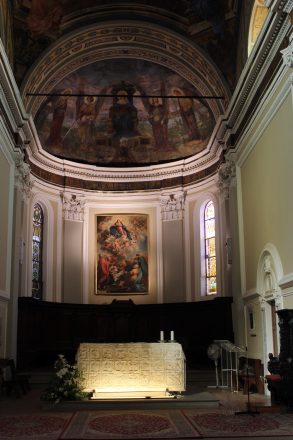
Inside, there is a remarkable pre-Romanesque antependium (9th century) recovered in 1964 from a Baroque altar in which it had been reused as a table and now inserted in the main altar.
The walnut choir dated 1614 has recently been restored. On the walls of the side naves some tombstones from different eras come from the ancient floor of the church.
HOW TO REACH IT :
The Duomo is located on one side of Piazza della Repubblica, in the center of Orbetello, a very short distance from the road that connects Orbetello to Monte Argentario (via Mura di Ponente).
IN THE SAME AREA YOU CAN ALSO VISIT:
Archaeological Park and National Museum of Cosa; Duna Feniglia nature reserve; Etruscan walls and Spanish walls of Orbetello.
IF YOU LIKED THE ORBETELLO CATHEDRAL YOU CAN ALSO VISIT:
Church of San Bruzio in Magliano (23 km); San Rabano Abbey in the Maremma Natural Park (37 km); Church of San Giorgio in Montemerano (48 km).
CURIOSITY':
The heads of San Biagio. According to tradition, some farmers, while plowing the fields at the foot of the Ansedonia hill, saw a human skull appearing among the clods; as they were about to collect it, the oxen yoked to the plow knelt down, whereupon they realized they were in front of the remains of San Biagio: they placed them in an urn and placed them in the nearby church, dedicated to the saint.
In 1414, when the Sienese conquered Orbetello and its territory, they stole the relics which were taken to the Cathedral of Siena; In 1434 the people of Orbetella asked for its restitution, which the Republic said it was ready to grant on condition that all expenses were reimbursed.
Subsequently, probably in the mid-16th century, the relics were moved from the church of San Biagio di Ansedonia to the Cathedral of Orbetello and were initially kept under the altar of San Giovanni, whose poor condition was complained of in 1570. In 1692 they were transferred to the chapel dedicated to the saint, built specifically for this purpose. The reliquary in which they were originally kept was stolen in 1892, a new one was then created in silver and precious stones, depicting the bust of the saint, by the Roman sculptor Cesare Aureli (1843-1923), inside which a golden wooden urn where the relics were placed. On November 23, 1960, the gems that adorned the bust were stolen, while on February 2, 2009, on the eve of the patron saint's day, the relic was stolen, never to be found again.
In reality, that of Orbetello is not the only known head of Saint Blaise: according to tradition, the saint died beheaded in Sebaste, Armenia, and his remains buried in the cathedral of that city. In 732 they were exhumed to be taken to Rome, but a storm wrecked the ship off the coast of Maratea, where the saint's body still rests today. The events of the head are more "adventurous": in addition to Orbetello, a skull that is said to belong to the saint is also found in the church of San Domenico a Penne, in the province of Pescara, a gift from Charles II of Anjou; another, inserted in a reliquary in the form of a Byzantine crown, is in Dubrovnik (Croatia), in the city's cathedral, of which San Biagio, like Orbetello, is the protector. Another head is kept in Naples, where it would have been brought there by Armenian nuns fleeing the iconoclastic struggles, kept first in San Gennaro all'Olmo, then in San Biagio Maggiore and finally in San Gregorio Armeno. A fragment of the skull from Naples was then brought to France in 1362 by Cardinal Guillaume de Grimoard, later pope with the name of Urban V, today preserved in the church of San Benedetto in Montpellier. Another fragment of the skull would be in Caramagna Piemonte (CN), preserved in a silver bust, the existence of which is
ha notizia fin dal 1028.
