

 City of Thing
On the top of the Ansedonia hill (113 m a.s.l.) stand the remains of the ancient city of Cosa.
The city was founded by the Romans in 273 BC. in the territory of the Etruscan city of Vulci, after its definitive defeat by the consul Tiberius Coruncanio in 280 BC. The colony was to constitute an important stronghold in the control of the Tyrrhenian Sea, whose shores Rome was able to conquer in a short time. Based on the extension of the city, over 13 hectares, it is estimated that the first inhabitants were around 4,000.
The city went through a period of crisis, also demographic, like many other centers of Etruria, during the Punic wars, so much so that, having overcome the danger of Hannibal, in 197 BC. another 1,000 settlers were sent there. A period of prosperity followed, the greatest sign of which is given, around 150 BC, by an intense building activity, which culminated with the construction of the Capitolium (the temple dedicated to Jupiter, Juno and Minerva), of the Basilica and with the of the port at the foot of the hill: the Portus Cosanus, located at the so-called “Tagliata Etrrusca”, an artificial channel actually created in Roman times precisely to avoid silting up the port.
In 90 BC obtained Roman citizenship, like all other Italian cities, but around 71 BC. it suffered a fire and looting that left it depopulated. The city remained abandoned until the Augustan era, when it was repopulated, perhaps by retired veterans of Augustus’ legions (20 BC).
Having come back to life, it prospered for about a century, and then gradually depopulated again, in favor of the areas at the foot of the hill, near the port and the Via Aurelia. An inscription from 236 AD. it signals the state of decay of the buildings of the forum and it is no coincidence that in the ancient itineraries the center of Succosa or Subcosa (“under Cosa”) is mentioned and no longer the ancient colony.
However, life had to continue, albeit with difficulty, even in the late imperial age. Claudius Rutilius Namatianus, who in the poem De Reditu Suo (the return) describes the coasts in front of which his ship passes, fleeing from Rome, in 415 AD, describes Cosa as completely
abandoned and in ruins and recalls a legend according to which the city was abandoned to
due to a rat invasion.
At the end of the 5th century, the arce was restructured and transformed into the headquarters of a garrison in control of the Via Aurelia. Destroyed after a few decades, it became a Byzantine garrison and outside it, in correspondence with the Roman forum, a small village was built on the remains of the ancient domus, with a church built in the area of the ancient Basilica. It is in this period that the city had to change its name from Cosa to Ansedonia.
It was certainly populated in the early Middle Ages and, with the rest of the Ager Cosanus it was donated by Charlemagne to the Roman monastery of S. Anastasio ad Aquas Salvias, known as the Three Fountains, according to tradition for the help given by the monastery to the king, who was in fact besieging Ansedonia, sending the relics of St. Anastasius to his army, in whose presence the walls were shaken by a violent earthquake which caused the enemies to flee in fear, allowing him to conquer the city.
The name of Ansedonia is present in the main documents of the following centuries, as a domain of the Aldobrandeschi counts, to whom the monks of the abbey had given it in long lease, and then of the Orsini who inherited the possessions by marriage after the death of the last countess palatine Margherita Aldobrandeschi. Finally conquered by the Republic of Siena, it was destroyed in 1330 to drive out a group of looters who had occupied it.
WHAT TO SEE:
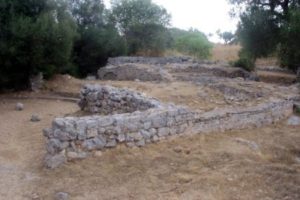
The most evocative monument of the archaeological area is the imposing wall in polygonal boulders, 1465 meters long, which included an area of over 13 hectares, embracing two small hills and the valley between them. The sections of the walls facing the sea were further fortified by 17 square towers, at a distance of about 30 meters from each other, corresponding approximately to an arrow shot and a single round tower. There were three access gates to the city: one to the north-west, called Porta Fiorentina, one to the north-east, called Porta Romana, perhaps the best preserved, and one to the south-east or Porta Marina. A postern also opened in the stretch that surrounded the acropolis and allowed to reach the cliff below approximately where the Tower of San Pancrazio stands today. The urban area, as is usual in cities founded by the Romans, was crossed by a regular road network, with all the streets paved in local stone, which delimited blocks intended for housing. The archaeological excavations, carried out since the Second World War, have brought to light some of them: among the most interesting the Casa dello Skeletro, close to the National Archaeological Museum, and the Casa di Diana, among those of more recent discovery. In the central valley was the forum, or the main square of the city, with the most important public buildings: the Basilica, seat of the archives and offices of the magistrates, the Curia, place of citizens’ assemblies, a temple dedicated to Concordia, prisons and various shops. At the highest point of the hill was the arch, with the most important temples: the Capitolium and the temple of Mater Matuta. From here you can enjoy a vast and evocative panorama, both on the coast of Lake Burano and on the Argentario and the Orbetello lagoon.
HOW TO REACH IT:
The archaeological area and the National Archaeological Museum of Cosa, located inside, can be reached from the Aurelia, for those coming from Grosseto taking the first exit for Ansedonia; for those coming from Rome, the second exit for Ansedonia.
Continue straight until you pass the railway overpass, then turn left and leave the fish ponds on your right. Appropriate signs then guide you to the top of the hill: turn left again into via delle Mimose, leaving the municipal road of Ansedonia on the right. Then turn left into via delle Ginestre until you come to a short dirt road that leads to the parking lot of the archaeological area, just outside Porta Fiorentina.
TIMETABLES:
Summer from 25 March 2018: from Monday to Saturday and first Sunday of the month 10.15am – 6.30pm. Entrance to the Archaeological Park is free; for access to the Museum: full ticket €2 – reduced €1
IN THE SAME AREA YOU CAN ALSO VISIT:
Etruscan Tagliata and Spacco della Regina; Orbetello;
Burano Lake Nature Reserve; Feniglia Dune Nature Reserve.
IF YOU LIKED THE ARCHAEOLOGICAL PARK OF WHAT YOU CAN ALSO VISIT:
Etruscan Walls of Orbetello (10 km); Vulci Archaeological Park (43 km); Saturnia (57 km)
