

 Vetulonia
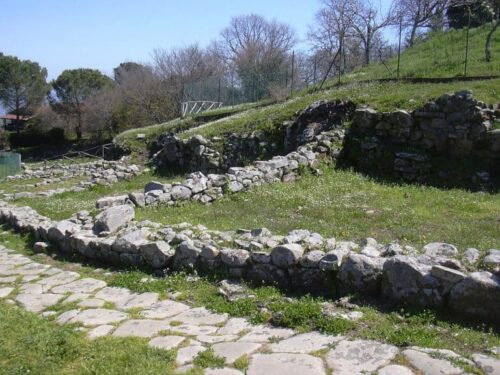
 was once one of the 12 dominant cities of Etruria until it was simply lost to history. All that remains today are the outlines of its buildings and streets and a magnificent museum dedicated to these pre-Roman goldsmith masters.
Vetulonia has Etruscan origins. In 600 B.C. it was part of the Etruscan League of 12 cities. Dionysius of Halicarnassus places the city in the Latin alliance against Rome in the 7th century BC. Clearly things did not go well because the city simply disappeared from the map.
Vetulonia seemed destined to remain a legend, until in May 1880 Isidoro Falchi “a physician in the service of archaeology” came across three Etruscan coins at Colonna di Buriano. Those three coins led to years of investigation, and in 1887, the King of Italy, Umberto I, reassigned Colonna di Buriano to the ancient name of Vetulonia.
Vetulonia has three main attractions. The first are the monumental Etruscan tombs unearthed at the foot of the hill that houses the city. All these graves are covered by mounds or grassy knolls, making them look a bit like hobbit holes. They are reached by taking the Via delle Tombe, a well-marked dirt road. Keep an eye out for the Tomb of the Pietrera, one of the oldest examples of monumental Etruscan tombs, dating from around 630 BC. Continuing along the tomb road you will find the Tomb of the Devil II and finally the Tomb of the Golden Fibula. These graves also date back to the 7th-6th centuries. FORWARD CHRIST. Some of these tombs can also be explored inside and all can be visited free of charge.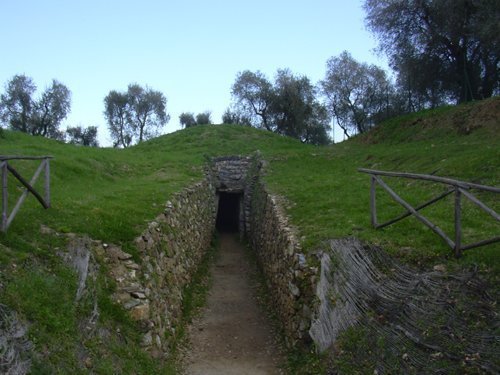
Many of the treasures found in these tombs, jewelry, oriental vases, chariots, helmets, shields, spears, statues, and gold and silver coins bearing the ancient name Vatl (Vatluna was the Etruscan toponym) are displayed in the city museum. This should be your second stop in Vetulonia.
The third and final attraction is somewhat disappointing. In the center of the village the remains of the Etruscan walls, large polygonal blocks enclosing an area of about 16 hectares, are visible. It is also possible to see part of the necropolis excavated by Isidore Falchi, but because funds are scarce, the potential of the site is still, for the most part, underground. However, it is open from June to September, 10 a.m. to 7 p.m., Tuesday to Sunday, and seven days a week from July to August.
