

 Fall
Fall
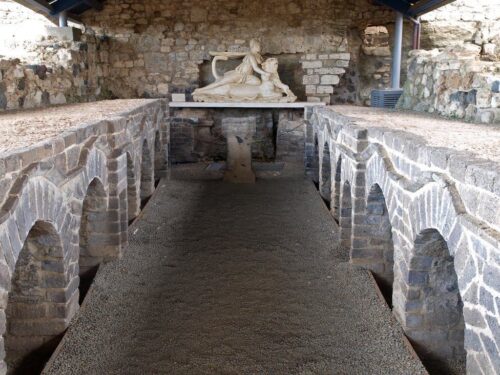
Perhaps the best preserved part of ancient Vulci, these tombs mostly date back to the period between the 8th and 4th centuries BC and remain a symbol of the importance that the Etruscans attributed to the act of honoring their dead.
Historians believe that many of Vulci’s tombs were plundered by grave robbers during the 16th-18th centuries and that their finest treasures were stolen. Yet, even empty, they remain magnificent and incredibly captivating.
Most important tombs
The François Tomb : Simply calling it a tomb is a bit of an understatement, after all it is one of the most important Etruscan monuments in the world. The François Tomb (above) is the only painted tomb in Vulci that can be visited today.
The rich frescoes that adorn the 5th century tomb depict scenes from ancient Rome, the mythological cycle of Nestor, the legend of the Seven against Thebes and the Trojan War. The frescoes also depict the story of Mastarna (known to the Romans as Servius Tullius, the sixth king of Rome) who freed Vibenna Caelius, an Etruscan leader imprisoned by Tarquinius of Rome. In the fresco the warriors of Mastarna fight the enemy flanked by the figures of Volsinii and Sovana. If the above image is not enough to inspire, then believe me, this tomb will leave you speechless.
The tomb proper is located in a large room surrounded by 11 smaller rooms, all carved into the rock. Historians believe that the tomb belonged to the noble Etruscan family Saties of Vulci.
Tomb of the Bronze Cart: whose beautiful decorations tell the story of the aristocratic family that was buried there.
Tomb of Iside (in the Necropolis of Polledrara) : in this tomb archaeologists have found some of the most beautiful works of art and sepulchral objects of Vulci. These include an alabaster plaster statue made in Rhodes, Egyptian flasks and scarabs, Greco-Oriental vases, and exquisitely decorated ostrich eggs (many of which are now on display at the National Museum of Vulci ) .
Tomb of the Sun and the Moon: Carved into the rock in the shape of an Etruscan house, this tomb was discovered in 1830. Fake beams and joists have been excavated on the roof of the tomb, while a fan is present in one room. Historians believe that the tomb imitates the type of house in which wealthy Etruscan aristocrats lived.
Cuccumella Tumolo: Discovered between 1828 and 1829, this immensely large mound is 18 meters long and 75 meters in diameter. Inside there is a long corridor that leads to a large open space. Cut into the rock, the room is surrounded by doors that open onto other burial chambers.
Sarcophagi of Ponte Rotte: Sacrophogi dating back to the 5th century. The most beautiful of these depicts married couples lying and embracing between winged girls. Slightly erotic, but that was the Etruscan style.
