

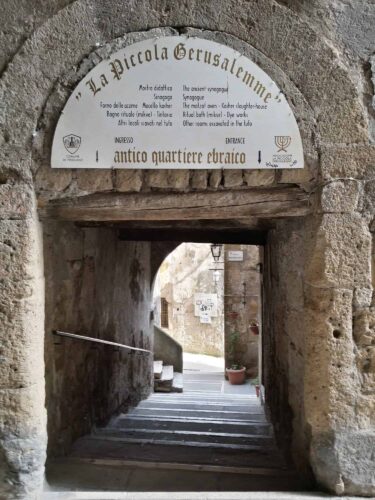
 Jewish ghetto
A Jewish presence in Pitigliano has been attested since the first half of the 15th century, but a real community was formed only after the mid-16th century, especially starting from the persecutions in the Papal States during the pontificate of Paul IV and Pius V and in Tuscany by the Medici, “forced” to please the pope in exchange for the grand ducal title.
The Orsini, lords of Pitigliano, generously welcomed the refugees, allowing them to open a “Bank of Loan” and to set up craft and commercial activities. Davide Pomis, a doctor resident in Magliano in Sabina, forced to leave his homeland, became the personal doctor of Niccolò Orsini between 1556 and 1561 who, in exchange for his services, donated him a plot of land just outside the town to build a burial place, nucleus of the future Jewish cemetery. The prosperity of the community in this period is evidenced by the construction of the Synagogue, which dates back to 1598. In 1608, with the passage of the county of Pitigliano to the Medici, for the first time the Jewish community underwent substantial limitations: they could only exercise certain activities and they had the obligation to wear a sign that distinguished them: a red hat for men and a red sleeve for women, and above all they were forced to live in a well-defined space, the ghetto, located approximately in the center of the southern edge of the tuffaceous plateau where the town stands.
With the passage to the Lorraines, conditions improved and the community flourished again. In the mid-1800s, the Jewish community reached its maximum expansion, with over 400 people, in a town of 2,200 inhabitants: this is the moment in which Pitigliano earned the nickname of “Little Jerusalem”.
After the unification of Italy the demographic decline of the community began: an ever-increasing number of Jews left Pitigliano to move to larger cities, to the point that between the 1920s and 1930s there were only 70 individuals, so much so that in 1931 the community was merged with that of Livorno, finally receiving the final blow with the racial laws of 1938. After the war the situation did not improve and today only very few Jewish citizens live in Pitigliano.
To be seen
The Ghetto area is now included in the Jewish Museum of Pitigliano, which extends to include, in addition to the Synagogue, the most characteristic buildings of Jewish life, almost always dug into the tuff. Worth mentioning is the Mikveh, a space used for the ritual bath that women performed at the end
of the menstrual period, before marriage and after childbirth, for which spring water or rain water had to be used; the Kosher wine cellar, to produce which no casein-based additives could be used and which was pasteurized at a higher than usual temperature; the space for the slaughter of animals according to the tradition of the Torah, according to which the animals had to be killed with a clean cut of the jugular and completely bled; the oven of unleavened bread, which was used only once a year, during the days of Passover, for
baking unleavened bread and sweets characteristic of the period and which was last used for Easter 1939; the dyeing and tannery: many Jews were in fact weavers and fabric traders.
How to get there
The entrance to the Jewish Museum is on vicolo Marghera, a crossroads of via Zuccarelli.
Timetables
From 1 April to 30 September: 10 -13.30 and 14.30-18.30. From 1 October to 31 March: 10am-12.30pm and 3-5.30pm. Closed on Saturdays.
Full ticket 3.00; reduced 2.00
In the same area you can also visit
Rocca Orsini with Diocesan Museum; Civic Archaeological Museum of Etruscan Civilization.
