

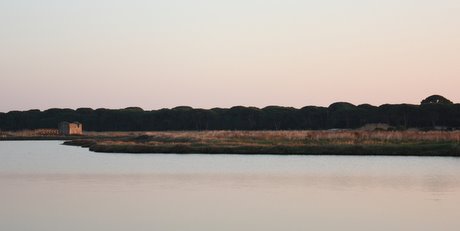
Diacca Botrona
The Diaccia Botrona nature reserve is located between Grosseto and Castiglione della Pescaia, and is one of the most important and well-known protected areas in Tuscany, due to the uniqueness of the environment and the extraordinary variety of wildlife species.
Diaccia Botrona
Diaccia Botrona is a marshy area of the Tuscan Maremma, one of the few remaining following the massive reclamation work begun under the Lorraines and completed in the 1950s and 1960s. This is the last margin of the Castiglione Marsh, which originally housed the ancient Trajan Port of the Romans. The area is divided into two zones, that of Diaccia and Botrona, one part of the marsh has retained its original freshwater characteristic, while the other part has become a brackish lagoon.
History
The present Diaccia Botrona is what remains of the ancient Lake Prile. In the beginning, there was a large saltwater lagoon, which, retreating little by little, originated this swamp, now a valuable ecosystem of microorganisms and natural habitat of many plant and animal species.
Ancient Lake Prile was extraordinarily important in Etruscan and Roman times; as early as 53 B.C. an oration by Pro Milone describes the existence of a villa owned by Clodius on one of the lake's small islands. In medieval times the lake was mainly used for fishing and salt mining.
Beginning in the 16th century, the countryside began to be depopulated, partly because of a terrible epidemic of the Black Death; moreover, it was decided to turn most of the cultivated land into pastureland. The farmers' abandonment of the land led to progressive degradation of the countryside and stagnant water, which soon turned the area into a swamp, where the anopheles mosquito, the carrier of malaria, developed. The conditions of this area therefore determined the need to proceed with a major land reclamation, which was implemented starting in the early 1800s, by the Lorraines. The reclamation of Maremma lands continued in alternating stages until 1960, with the great Agrarian Reform of the Ente Maremma.One of the symbols of the reclamation is the Ximenes Red House, a grandiose engineering work built by the Jesuit engineer Leonardo Ximenes, commissioned by the Counts of Lorraine.
The nature reserve
The Diaccia Botrona nature reserve covers about 1,000 hectares between the municipal territories of Grosseto and Castiglione della Pescaia.
The establishment of a nature reserve dates back to 1971 when it was declared a "wetland of international value under the Ramsar Convention." Diaccia Botrona is also considered a "gene bank" of inestimable value; in fact, many plant, animal and microorganism varieties find their natural habitat here.
Flora :
The vegetation of Diaccia Botrona Nature Reserve varies greatly depending on the area of reference:
- the marsh area sees the presence of marsh reed, halophilous plants that have arisen mainly as a result of increasing water salinity, then saltcedar, limonium, bulrush, crypsis aculeata and juncus subulatus.
- The sandy area, on the other hand, is home to oxbow ash trees, elms, willows, white poplars, domestic pines, holm oaks, downy oaks, and Mediterranean scrub of rosemary, cistus, myrtle, lentisk, heather arborea, phillyrea angustifolia, and juniper lici.
- Seaward the vegetation consists of phillyrea, juniper, heather, rosemary, myrtle, anthemis marittimus, medicago marina, ammophila arenaria
Fauna:
The avifauna of Diaccia Botrona Nature Reserve is particularly diverse, with records of bittern, purple heron, marsh harrier, flamingo, greylag goose, mallard, teal, wigeon, great egret, osprey, hen harrier, crane, snipe, redshank, redshank, stilt, stone curlew, sea jay, tufted cuckoo, grey heron and egret.
Mammals that inhabit the nature reserve include porcupine, hare, hedgehog, marten, weasel, nutria, rat and vole.
Instead, the main fish species are represented by mullet, bass and eel.
Finally, the reptiles, grass snake, waxworm, collared snake, orbettino, tortoise and green lizard, and the amphibians, lesser green frog, emerald toad, Italian crested newt and tree frog.
Ximenes Red House
Located at the entrance to Diaccia Botrona, it was designed in 1765 by Jesuit engineer Leonardo Ximenes as part of the great reclamation work implemented by the Counts of Lorraine.
The building consists of a large body with three large arches leaning against it, and was used to control water runoff.
Today the Ximenes Red House is home to the Diaccia Botrona visitor center and the Multimedia Museum.
DIACCIA BOTRONA NATURE RESERVE
Via Casa Rossa Ximenes, 58043 Castiglione della Pescaia GR
Tel. 347 5345189 - 339 4331553
OPENING HOURS AND PRICES
September to May Thursday through Sunday from 1 p.m. to 7 p.m.
June to August daily except Thursdays from 4 p.m. to 10 p.m.
Full € 12.00
Reduced € 10.00
Children from 5 to 12 years old € 6.00
RED HOUSE XIMENES
CLODIA ISLAND
info
