

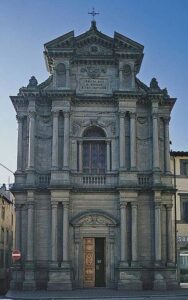
 Church of Our Lady of Grace
Built in the Renaissance style, this church stands out from the others because of its striking facade, made entirely of peperino, a brown or gray tuff rock embedded with fragments of basalt, limestone, and various crystals.
Castel del Piano had the church built in the early 16th century. If you look closely at one of the outside walls, you can see a small inscription and niche said to have been used for the “collection of obols for the ransom of Christian slaves” (1656).
Built in the Renaissance style, this church stands out from the others because of its striking facade, made entirely of peperino, a brown or gray tuff rock embedded with fragments of basalt, limestone, and various crystals.
On the left wall is a 19th-century adaptation of “The Assumption” by Castel del Piano artists Anna Mosses and Alexander Teerlink, as well as a copy of a painting by Spanish painter Murillo-the original is currently on display at the Hermitage Museum in St. Petersburg.
The church’s magnificent 18th-century central altar is adorned with a gold-inlaid panel by Sano di Pietro (15th century) and depicts the Madonna and Child between Saints John the Baptist and Bartholomew and angels.
This tablet is so beautiful that there are several copies all over the world. One is at the Museum of Art in El Paso, Texas, another at the Vatican, this time painted by Gioacchino Sorbelli in the 18th century, and another at Palazzo Nerucci in Castel del Piano, copied by Francesco Nasini.
